We tendered into Sihanoukville. Since it was raining, no one was able to sit on top. The one hundred and twenty passengers were huddled inside the boat trying to stay dry. The driver of the boat was very focused on getting us to shore from the ship. The waves were rough and we were rocking back and forth.
It was early and everyone was very quiet. As we sat there, I thought of the people who had fled from Cambodia and Vietnam during wartime. A lot of the people had escaped in boats that lacked a sign saying "maximum occupancy" found in our tender. The people that were fleeing from their country were thankful just to be on a boat to escape the brutality. The twenty to thirty minute ride to shore seemed long.
I really did not know what to expect to see in this city that had been through many wars and lots of hardship. Our bus driver and guide were waiting for us as we docked.
Our tour guide spoke good English and he was excited to take our group to visit his city.
Cambodia is located in the southern portion of the Indochina Peninsula in Southeast Asia. It is bordered by Thailand to the northwest and Laos to the northeast and Vietnam to the east and the Gulf of Thailand to the southwest.
One of the first stops was at the War Memorial to remember the two to three million Cambodians that had been murdered between 1975 to 1979. The Cambodia genocide was at the hands of Khmer Rouge's regime and Pol Pots troops.
The bus then took us to the Wat Krom, Buddhist Temple. It has a unique and beautiful architecture as well as a view over Sihanoukville and the sea. As we entered the temple area, we were greeted by the homeless children and a beggar. We observed some of the monks walking from one temple area to the next.
As we drove through the city, I observed the trash and how the men were constructing buildings, one brick at a time. There did not seem to be any urgency in completing the buildings. Also, you noticed men welding while standing in water and wearing glasses, but not wearing helmets or other safety garments.
I did meet a couple on the ship, who told me that they were in the construction business in Australia. As they travel into third-world countries and they see these men on the construction sites without the proper safety equipment, they will purchase safety items and give them to the workers. They said the workers are all appreciative of their gifts. The companies don't pay for safety equipment and the workers have to purchase their own.
I had read that Cambodia is one of the poorest countries in the world. About one third of the population live on less than a $1.00 a day. The population of Cambodia is sixteen million and the town we were in the population is approximately two hundred thousand.
Our guide took us a "typical" Khmer village to meet a family and to see how they live. The father works for the government and was not at home. The wife and twin three year old boys with the grandparents were at the house to greet us. The grandmother was in the back washing the clothes out of a bucket and the mother was inside their one room sweeping. In the one room was a bed and the kitchen area had a small gas stove.
The other homes in the area were tents with some wood paneling holding it together.
The majority of the roads were dirt and due to the tropical storm, Tembin, that had come through the roads were very muddy.
The rewarding part of the excursion was visiting the local private school. As the bus pulled up, students were being dismissed from the morning classes. The students either attend in the morning or in the afternoon. At this school, there were about one hundred-fifty students. One class waited to be dismissed until our group was able to come in and meet the students and the teacher. The students were dressed in an uniform and had bright, big smiles on their faces. They were happy to meet us. The children loved high-fiving with Kenny.
When I signed Kenny and myself up for this tour, it was recommended that we bring gift items, such as school stationery, pens, rulers, scissors, etc. I purchased and brought materials with me, but after seeing the school's condition, I felt that I should have brought more supplies.
The property of the school was very run down. There were no pathed sidewalks. Trash was everywhere. Even as I looked at these conditions, I felt the warmth of happiness from these children and teacher.
We were at the school for only about fifteen minutes and then we were off to the Psar Lu Market. It was very crowded. The market had everything. There were trinkets, clothes, fruit, vegetables, eat.
To end the day, we were then driven to the beach, where there was a nice hotel and a resort is being built there.
As I looked at the beautiful white sandy beaches and the blue water, I reflected on the contrast of the city. It was hard to comprehend that only a few miles away, people were living in poverty. I am wondering how could I make a difference to this country?
Sunday, December 31, 2017
Six Hours In Ho Chi Minh City, Vietnam
It is Christmas Eve and I am celebrating my birthday in Ho Chi Minh City, Vietnam or as others know it - Saigon.
The ship docked and we boarded the bus for the 1 1/2 hour drive to Saigon.
As we got closer to the city, from the bus we could hear the honking horns and see the street hawkers and the motorbikes zooming in every direction. I was in awe of the tall skyscrapers and the retailers such as Versace, Chanel, Gucci, Prada, etc.
Our guide informed us that the Vietnamese want Ho Chi Minh City to be the next Hong Kong. I would definitely say that it is headed in that direction.
The city lies along the western bank of the Saigon River and north of the Mekong Delta. It is about two hours north of the ocean and it does have a tropical climate with an average humidity of 75%.
Ho Ch Minh City has a population of 10 million with about 8 million motorbikes. The monthly tax for a motorbike is $30 compared to the monthly tax of $1,000 for a car. So needless to say, that is the reason why there are so many more motorbikes.
The city was once a part of the Cambodia Kingdom until about the 17th century when the Vietnamese first gained entry into the area. In 1859, it was conquered by France.
France occupied Saigon for less than a hundred years. During that time, the wide tree-lined boulevards, sprawling parks and classical European structures would earn the city the nickname “Paris of the Orient”.
Following the fall of Saigon on April 30, 1975, Saigon was renamed Ho Chi Minh Vity to honor North Vietnam’s revolutionary leader, Ho Chi Minh.
English is well spoken in the city. English is a mandatory subject from the beginning age of six until they graduate at 17.
We only had about six hours in the city. During that time, we were able to see the Notre Dame Cathedral. It was completed in the 1880’s. The Cathedral is the largest church ever built in the French empire and it has two 190 feet tall bell towers.
Across from the Cathedral sits the stunning Main Post Office, the largest of its kind in Vietnam. It was built between 1886 & 1891 by renowned architect Gustavo Eiffel. It’s neoclassical design features an interior reminiscent of a European railway station complete with arched windows & a vaulted ceiling.
Other sites that we saw were the buildings from the Vietnamese War, such as the Rex Hotel and the building that we he helicopter landed on to evacuate people after the fall of Saigon.
The Minh Phuong Lacquer Factory was an interesting site. We observed the workers in making the lacquerware. There is a huge warehouse filled with items ranging from small boxes to large pieces of furniture.
We enjoyed a traditional Vietnamese water puppet show at the National Museum’s Theater.
Some other ways that people get around the city is by a pedi-cab, a small pedal-operated vehicle or by a cyclo, which is a three-wheeled bicycle with a large passenger seat in the front.
Even though we only had about six hours in Ho Chi Minh City, we felt that we got to experience and understand the people of Saigon. The highlight was sitting in a Cafe watching the millions of motorbikes zoom by!
The ship docked and we boarded the bus for the 1 1/2 hour drive to Saigon.
As we got closer to the city, from the bus we could hear the honking horns and see the street hawkers and the motorbikes zooming in every direction. I was in awe of the tall skyscrapers and the retailers such as Versace, Chanel, Gucci, Prada, etc.
Our guide informed us that the Vietnamese want Ho Chi Minh City to be the next Hong Kong. I would definitely say that it is headed in that direction.
The city lies along the western bank of the Saigon River and north of the Mekong Delta. It is about two hours north of the ocean and it does have a tropical climate with an average humidity of 75%.
Ho Ch Minh City has a population of 10 million with about 8 million motorbikes. The monthly tax for a motorbike is $30 compared to the monthly tax of $1,000 for a car. So needless to say, that is the reason why there are so many more motorbikes.
The city was once a part of the Cambodia Kingdom until about the 17th century when the Vietnamese first gained entry into the area. In 1859, it was conquered by France.
France occupied Saigon for less than a hundred years. During that time, the wide tree-lined boulevards, sprawling parks and classical European structures would earn the city the nickname “Paris of the Orient”.
Following the fall of Saigon on April 30, 1975, Saigon was renamed Ho Chi Minh Vity to honor North Vietnam’s revolutionary leader, Ho Chi Minh.
English is well spoken in the city. English is a mandatory subject from the beginning age of six until they graduate at 17.
We only had about six hours in the city. During that time, we were able to see the Notre Dame Cathedral. It was completed in the 1880’s. The Cathedral is the largest church ever built in the French empire and it has two 190 feet tall bell towers.
Across from the Cathedral sits the stunning Main Post Office, the largest of its kind in Vietnam. It was built between 1886 & 1891 by renowned architect Gustavo Eiffel. It’s neoclassical design features an interior reminiscent of a European railway station complete with arched windows & a vaulted ceiling.
Other sites that we saw were the buildings from the Vietnamese War, such as the Rex Hotel and the building that we he helicopter landed on to evacuate people after the fall of Saigon.
The Minh Phuong Lacquer Factory was an interesting site. We observed the workers in making the lacquerware. There is a huge warehouse filled with items ranging from small boxes to large pieces of furniture.
We enjoyed a traditional Vietnamese water puppet show at the National Museum’s Theater.
Some other ways that people get around the city is by a pedi-cab, a small pedal-operated vehicle or by a cyclo, which is a three-wheeled bicycle with a large passenger seat in the front.
Even though we only had about six hours in Ho Chi Minh City, we felt that we got to experience and understand the people of Saigon. The highlight was sitting in a Cafe watching the millions of motorbikes zoom by!
Wednesday, December 27, 2017
A Day in Nha Trang, Vietnam
We tendered into the port of Nha Trang for the day. We were greeted by the locals with the young ladies wearing their native clothing that were of silk with a vibrant purple and yellow coloring.
A market had been set up for the passengers on the dock. There was a wide selection of items, such as handicrafts, lacquerware, silk, ceramics and even Under Armour.
Our guide began the tour by speaking about Nha Trang. It is tucked on the south central coast of Vietnam and lies at the mouth of the Cai River. The population is approximately 400,000. The climate is normally sunny all year round with an average temperature of 73 degrees(F). Due to the tropical storm in the area, it was partially overcast all day long.
Even though we were in the city, one could observe the beautiful rolling landscape in the distance. Our guide spoke about the small villages, terraced rice paddies, lush bamboo groves and the occasional water buffalo.
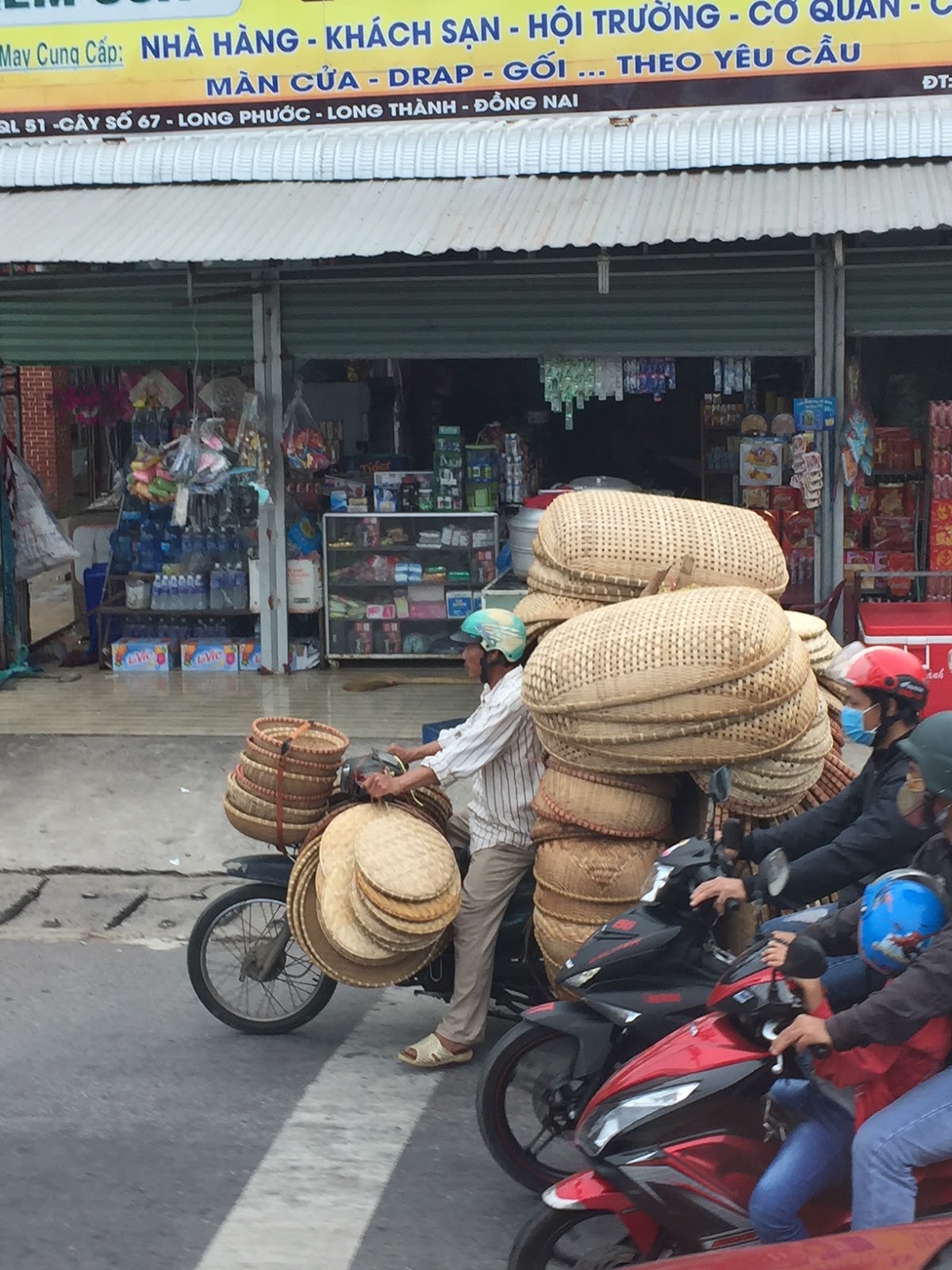
As we drove through the city, I could see the palm trees; long, lazy white beaches and the teal ocean to the right of me. I now could understand why Nha Trang is often called the "Miami of Vietnam". To the left of me were the shops and restaurants and crowds of people of people as well as the motorbikes. The motorbikes would not have just one person one them, but there could be a family of four on one bike. There would be other motorbikes that would be carrying a cargo of supplies.
It was interesting to see that along the sidewalk, there would be a mirror on the fence and a barber chair on the sidewalk. These were set-up to cut the men's hair. I saw several at work.
It was a site to see the spider-web of electrical wiring. All I could think of was how does one keep from being electrocuted?
Nha Trang dates back to the 2nd century A.D. To the north of the city is Ponagar Cham Towers, overlooking the Cai River. The towers are actually a complex of four intricately curved towers set within the lush tropical gardens. Each tower was built in honor of a distinct Hindu deity.
From the towers, we then got into a boat and cruised along the Cai River. We observed how the people lived. The homes were very simple with their clothes hung out to dry and with their food cooking on the stoves outside.
Back on the bus, we headed to the Cathedral that was located on a hill overlooking the city. This cathedral is one of the first and oldest buildings in the city to be build primarily of steel reinforced concrete. It was built between 1928 and 1933, the French Gothic structure has two personalities; the facade features an elegant square clock tower and stained glass windows, while inside you'll find red neon lighting on the crucifix and pink back-lighting on the tabernacle.
As we walked from one site to another, we could smell the local cuisine. The various herbs and spices that are used are lemongrass, ginger, mint, cinnamon, chili and basil leaves.
The drink specialties are sugar cane juice and a "bia hot" or fresh beer poured over ice. My husband did try the local beer, 333. He said it was very nice.
Going back to the ship, we noticed the cable car, stretching over 10,000 feet(it is the world's longest over water cable car). The cable car goes from Nha Trang to the Vinpearl Amusement Park.
The beaches are beautiful and the city is crowded with people and motorbikes. There is lots of building going on with the people building themselves. One did not notice any cranes or other building equipment. Trash is everywhere.
The people are very happy and thankful to have the tourist to assist with their economy.
A market had been set up for the passengers on the dock. There was a wide selection of items, such as handicrafts, lacquerware, silk, ceramics and even Under Armour.
Our guide began the tour by speaking about Nha Trang. It is tucked on the south central coast of Vietnam and lies at the mouth of the Cai River. The population is approximately 400,000. The climate is normally sunny all year round with an average temperature of 73 degrees(F). Due to the tropical storm in the area, it was partially overcast all day long.
Even though we were in the city, one could observe the beautiful rolling landscape in the distance. Our guide spoke about the small villages, terraced rice paddies, lush bamboo groves and the occasional water buffalo.
As we drove through the city, I could see the palm trees; long, lazy white beaches and the teal ocean to the right of me. I now could understand why Nha Trang is often called the "Miami of Vietnam". To the left of me were the shops and restaurants and crowds of people of people as well as the motorbikes. The motorbikes would not have just one person one them, but there could be a family of four on one bike. There would be other motorbikes that would be carrying a cargo of supplies.
It was interesting to see that along the sidewalk, there would be a mirror on the fence and a barber chair on the sidewalk. These were set-up to cut the men's hair. I saw several at work.
It was a site to see the spider-web of electrical wiring. All I could think of was how does one keep from being electrocuted?
Nha Trang dates back to the 2nd century A.D. To the north of the city is Ponagar Cham Towers, overlooking the Cai River. The towers are actually a complex of four intricately curved towers set within the lush tropical gardens. Each tower was built in honor of a distinct Hindu deity.
From the towers, we then got into a boat and cruised along the Cai River. We observed how the people lived. The homes were very simple with their clothes hung out to dry and with their food cooking on the stoves outside.
Back on the bus, we headed to the Cathedral that was located on a hill overlooking the city. This cathedral is one of the first and oldest buildings in the city to be build primarily of steel reinforced concrete. It was built between 1928 and 1933, the French Gothic structure has two personalities; the facade features an elegant square clock tower and stained glass windows, while inside you'll find red neon lighting on the crucifix and pink back-lighting on the tabernacle.
As we walked from one site to another, we could smell the local cuisine. The various herbs and spices that are used are lemongrass, ginger, mint, cinnamon, chili and basil leaves.
The drink specialties are sugar cane juice and a "bia hot" or fresh beer poured over ice. My husband did try the local beer, 333. He said it was very nice.
Going back to the ship, we noticed the cable car, stretching over 10,000 feet(it is the world's longest over water cable car). The cable car goes from Nha Trang to the Vinpearl Amusement Park.
The beaches are beautiful and the city is crowded with people and motorbikes. There is lots of building going on with the people building themselves. One did not notice any cranes or other building equipment. Trash is everywhere.
The people are very happy and thankful to have the tourist to assist with their economy.
Wednesday, December 20, 2017
Kuala Lumpur, Malaysia
Another active morning as the Princess Sapphire came into Port Kelang. The various teams of men were waiting on the dock to bring the Princess in. That is something to watch!
Today was going to be a ship day for myself. A day of pampering, a facial and massage.
I chose not to go into Kuala Lumpur, as it was going to be a short day at port. The city is about 30 miles form the cruise terminal. Also, a friend of mine, who travels to Kuala Lumpur for work had told me the city is very modern and had a New York feel.
But if you are ever in the area, some points of interest are:
Petronas Twin Towers = Reaching over 1,400 feet into the air. This is the world's tallest twin towers. A sky bridge connects the two towers at the 41st and 42nd floors. I am sure this would be spectacular to see, but heights aren't for me.
Kuala Lumpur Tower = A telecommunications and broadcasting tower that features shops, an open-air amphitheater, an observation deck and a revolving restaurant to see the spectacular view of Kuala Lumpur.
Batu Caves = One of the most popular Hindu shrines outside of India. There are 272 steps that lead to the temple cave. The people on board the boat said it reminded them of the Mayan Temple ruins in Mexico.
Some of the other passengers from the ship chose to go to various restaurants to try out the local cuisine. The different dishes are the Apam balik which is a Malaysian peanut pancake stuffed with roasted peanuts and sugar crumbs. Some street snacks are deep fried sweet potato balls, Malaysian beef/pork jerky and vegetable spring rolls called popiah. The food was pretty tasty.
The enjoyment of being on a cruise is finding what works for you!
Today was going to be a ship day for myself. A day of pampering, a facial and massage.
I chose not to go into Kuala Lumpur, as it was going to be a short day at port. The city is about 30 miles form the cruise terminal. Also, a friend of mine, who travels to Kuala Lumpur for work had told me the city is very modern and had a New York feel.
But if you are ever in the area, some points of interest are:
Petronas Twin Towers = Reaching over 1,400 feet into the air. This is the world's tallest twin towers. A sky bridge connects the two towers at the 41st and 42nd floors. I am sure this would be spectacular to see, but heights aren't for me.
Kuala Lumpur Tower = A telecommunications and broadcasting tower that features shops, an open-air amphitheater, an observation deck and a revolving restaurant to see the spectacular view of Kuala Lumpur.
Batu Caves = One of the most popular Hindu shrines outside of India. There are 272 steps that lead to the temple cave. The people on board the boat said it reminded them of the Mayan Temple ruins in Mexico.
Some of the other passengers from the ship chose to go to various restaurants to try out the local cuisine. The different dishes are the Apam balik which is a Malaysian peanut pancake stuffed with roasted peanuts and sugar crumbs. Some street snacks are deep fried sweet potato balls, Malaysian beef/pork jerky and vegetable spring rolls called popiah. The food was pretty tasty.
The enjoyment of being on a cruise is finding what works for you!
Monday, December 18, 2017
Langkawi, Malaysia
The sun was rising as we entered into the port in Langkawi. The spectacular orange color sun reflected off the water with the green, lush islands in the background. This is how I imagined Malaysia to appear.
Langkawi is located just 18 miles off Malaysia's northwestern coast and is actually a cluster of 99 islands in the Andaman Sea, just south of Malaysia's border with Thailand. The population is only about 65,000 compared to the other cities of Malaysia which are approximately 1.5 to 2 million people.
As we stepped off of the ship, you knew you were in a tropical climate with a temperature of around 93 degrees.
The excursion that my husband and I chose was the Kilim River/Mangrove Cruise.
The bus headed towards the Kilim Marine Park, a 38 square mile park which features green mangrove forests with beaches and lagoons. As we got to the park, we unloaded the bus and headed towards the boats that would take us to the various sites. Our first stop was the Bat Cave. As we stepped through the dark cave, you could feel the cool air on your face and the feel the bats as they flew over your head.
Stepping out of the cave, our group was met by a Macaque monkey, who was definitely looking for food. The monkey saw something shiny as a lady passed by and it jumped on her and grabbed the red shiny package. It ran up into the top of the tree and proceeded to tear the package and was very upset as it realized it was only a package of baby-wipes. It wasn't what it was looking for!
From the cave, we got back into the boats and headed towards the area where the brown and white eagles live. As we cruised along, we saw some iguanas that were climbing in the trees.
What a beautiful site to see the eagles nesting in the trees, as well as flying across the river from one tree to the next.
The other excursions that one can enjoy is the cable car that you will take to Mount Mat Cincang, Langkawi's second highest peak, soaring over 2,000 feet above sea level.
This is definitely an island that you will want to come and relax and enjoy the surroundings!
Langkawi is located just 18 miles off Malaysia's northwestern coast and is actually a cluster of 99 islands in the Andaman Sea, just south of Malaysia's border with Thailand. The population is only about 65,000 compared to the other cities of Malaysia which are approximately 1.5 to 2 million people.
As we stepped off of the ship, you knew you were in a tropical climate with a temperature of around 93 degrees.
The excursion that my husband and I chose was the Kilim River/Mangrove Cruise.
The bus headed towards the Kilim Marine Park, a 38 square mile park which features green mangrove forests with beaches and lagoons. As we got to the park, we unloaded the bus and headed towards the boats that would take us to the various sites. Our first stop was the Bat Cave. As we stepped through the dark cave, you could feel the cool air on your face and the feel the bats as they flew over your head.
Stepping out of the cave, our group was met by a Macaque monkey, who was definitely looking for food. The monkey saw something shiny as a lady passed by and it jumped on her and grabbed the red shiny package. It ran up into the top of the tree and proceeded to tear the package and was very upset as it realized it was only a package of baby-wipes. It wasn't what it was looking for!
From the cave, we got back into the boats and headed towards the area where the brown and white eagles live. As we cruised along, we saw some iguanas that were climbing in the trees.
What a beautiful site to see the eagles nesting in the trees, as well as flying across the river from one tree to the next.
The other excursions that one can enjoy is the cable car that you will take to Mount Mat Cincang, Langkawi's second highest peak, soaring over 2,000 feet above sea level.
This is definitely an island that you will want to come and relax and enjoy the surroundings!
Penang, Malaysia
Five days ago, we left Singapore and headed to Malaysia. Our first port was Penang. It is located on the west coast of Malaysia.
As we stepped off the ship, one could feel the heat & humidity. We were greeted by a group of local dancers.
Penang remained under the British colonial rule until 1957 when Malaysia gained it’s independence. There is still a lot of reminders of Britian’s Imprint. Even though Penang has an European style, there are lots of temples, mosques & Chinese clan houses.
Penang was named Pulau Penang by the Portuguese. It was officially settled in 1786 by a British trader and captain, Sir Francis Light, on behalf of the East India Trafing Company.
Penang was an important trade route for Europe, the Middle East, India & China.
The primary language is Bahar Malay, but English is widely spoken.
The various things you can do in Penang is visit the Butterfly farm, which houses over 100 species of live butterflies, the Penang Museum, The Reclining Buddha, Kek Lok Si(the Temple of Paradise, which is the largest Buddhist temple), and many more sites.
The people in Penang were very friendly & helpful.
As for food, Penang is known as the food capital of Malaysia. Val Kurt the, which translates as “meat bone tea” is actually a soup of meaty pork ribs and meatballs simmered in a broth of herbs & spices.
St, George Church, which is almost 200 years old, is the oldest Anglican Church in Southeast Asia.
Put on your walking shoes and enjoy the city!
As we stepped off the ship, one could feel the heat & humidity. We were greeted by a group of local dancers.
Penang remained under the British colonial rule until 1957 when Malaysia gained it’s independence. There is still a lot of reminders of Britian’s Imprint. Even though Penang has an European style, there are lots of temples, mosques & Chinese clan houses.
Penang was named Pulau Penang by the Portuguese. It was officially settled in 1786 by a British trader and captain, Sir Francis Light, on behalf of the East India Trafing Company.
Penang was an important trade route for Europe, the Middle East, India & China.
The primary language is Bahar Malay, but English is widely spoken.
The various things you can do in Penang is visit the Butterfly farm, which houses over 100 species of live butterflies, the Penang Museum, The Reclining Buddha, Kek Lok Si(the Temple of Paradise, which is the largest Buddhist temple), and many more sites.
The people in Penang were very friendly & helpful.
As for food, Penang is known as the food capital of Malaysia. Val Kurt the, which translates as “meat bone tea” is actually a soup of meaty pork ribs and meatballs simmered in a broth of herbs & spices.
St, George Church, which is almost 200 years old, is the oldest Anglican Church in Southeast Asia.
Put on your walking shoes and enjoy the city!
Sunday, December 17, 2017
Night Safari at the Singapore Zoo
It was another hot and humid evening in Singapore. Our evening was beginning at the zoo. This zoo was the first to introduce Night Safari Tours. It houses over 2,500 animals representing over 130 species of which 38% are threatened species.
We boarded the tram with about 80 other passengers. Our guide took us through the park to discover the various wildlife. These animals are made visible by lighting that resembles moonlight.
As the tram took off, the first animal that we encountered was the Markhor. Some were sleeping, where others were roaming.
In the distance, we could hear a laughing noise. We were approaching the striped hyenas. There was a pack of them roaming the area.
Everybody in the tram were excited and pictures were definitely being taken. You definitely need a night camera to take adequate photos of the animals.
Turning a bend, we could see a male lion sitting on top of a rock. He was keeping watch over his territory.
Other animals that we saw in the wild were bears, elephants, rhinoceros and hippopotamus.
After we got off the tram, we took off on several trails to see the wallabies and even observed a hippopotamus being fed.
This is a tour that I would definitely do again!
We boarded the tram with about 80 other passengers. Our guide took us through the park to discover the various wildlife. These animals are made visible by lighting that resembles moonlight.
As the tram took off, the first animal that we encountered was the Markhor. Some were sleeping, where others were roaming.
In the distance, we could hear a laughing noise. We were approaching the striped hyenas. There was a pack of them roaming the area.
Everybody in the tram were excited and pictures were definitely being taken. You definitely need a night camera to take adequate photos of the animals.
Turning a bend, we could see a male lion sitting on top of a rock. He was keeping watch over his territory.
Other animals that we saw in the wild were bears, elephants, rhinoceros and hippopotamus.
After we got off the tram, we took off on several trails to see the wallabies and even observed a hippopotamus being fed.
This is a tour that I would definitely do again!
Subscribe to:
Posts (Atom)